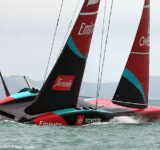
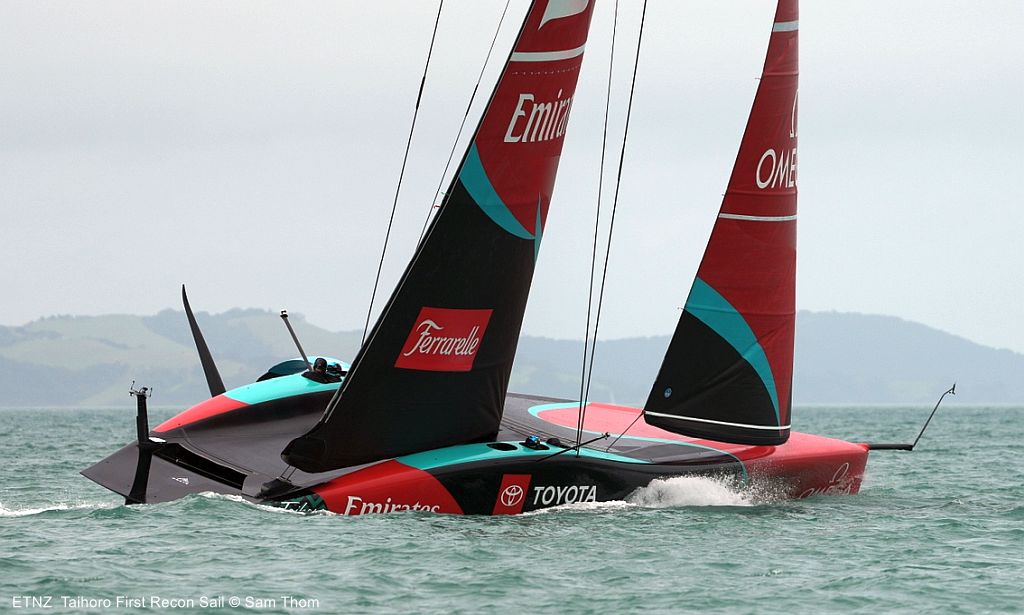
Emirates Team New Zealand took flight in their re-configured Taihoro, the first sail under RECON surveillance as required by the AC38 Protocol.
The five-hour session started with a systems check before dock-out and a long tow and what appeared to be some non-hardware technical issues, ETNZ hoisted sails starting with mainsail and the J3 and later they changed to a J2, which has a luff approximately a couple of metres longer than the J3.
Overall, considering that ETNZ had three new crew onboard, the boat looked very stable when sailing in a straight line, and their manoeuvres improved progressively throughout the day. Two the most interesting technical elements observed were the Mainsail Traveller Fairing and the Foil Cant system logic during tacks and gybes.
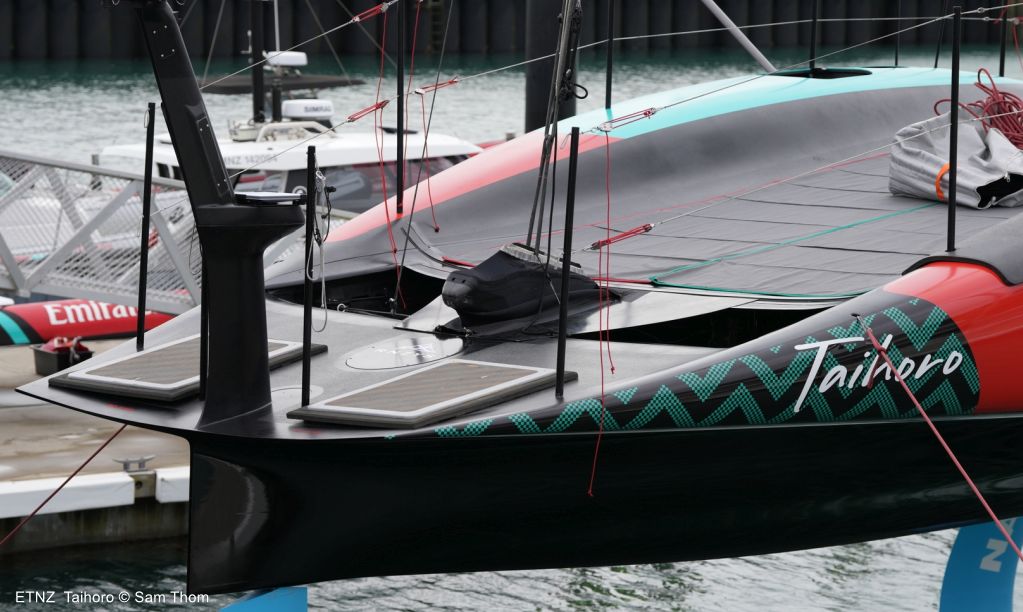
During tacks, as soon as the new foil board begins to drop, the boat reduces heel almost to leeward heel. At that stage, the new foil appears to deploy with a cant angle narrower than the foil currently supporting the boat, inducing windward heel during the exit phase of the tack and increasing the effective cant on the outside-turn foil.
Once the old board starts to retract, the new foil progressively increases its cant angle until it matches the target cant for steady-state sailing. A similar control logic appears to be used during gybes, although with different system settings.
Nathan Outteridge, skipper of ETNZ commented regarding Cant settings into the tacks and linked systems with the mainsheet traveller. “I think ultimately, like everyone knows that the cant helps the boats turn, so when you’re prepping for tacks, you’ll be canting out to help the boat turn up. You can do things with sequencing, but you can also completely just separate the aero from the foils as well.
He was coy about the details . . . “I’d really prefer not to get into the details, but I appreciate the question because ultimately that’s where this Cup’s going to be. It’s about those tiny details to try and get more performance out of the boat in those manoeuvres.”
Asked specifically about Jo Aleh’s role as the fifth person onboard, Nathan added: “She’s monitoring the performance of the boat and the trim of the sails. I think one of the cool things about this Cup is now we’ve got that fifth person who can get involved in different parts, so definitely focused on trimming the sails and really sort of helping us.
Regarding the battery power that has replaced the cyclors, Nathan said: “The new power routing system on our boat’s really good. I think the way they’ve spec’d the rules seems about right. We obviously didn’t sail in a heap of breeze today, but what we sailed in felt really similar in terms of power supply to the boat. There were definitely moments where we wish we could move things quicker than we were, just like in the last campaign.”
“So, I think it hasn’t been over-spec’d, it’s definitely not under-spec’d, and I think our guys have done a fantastic job of getting the new power system into the boat, and everything was working really nicely today. So nice job by the team, but also I think for the guys putting the rule together, it seems a really good balance there.”
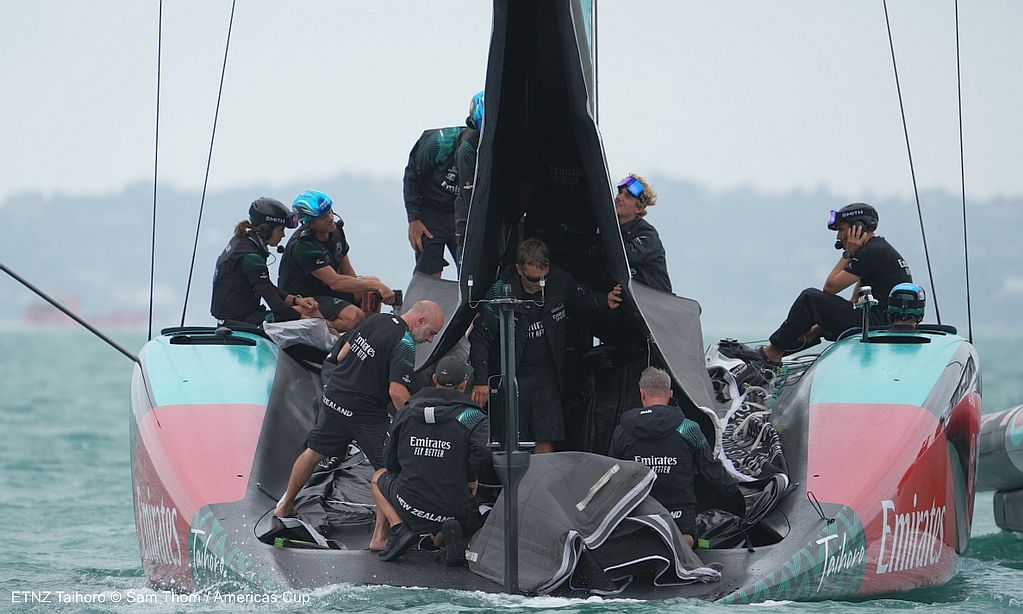
With the cyclors replaced by batteries, and an overall weight reduction of the new generation AC75 yachts, Nathan said: “It was nice to feel it lighter. There were moments where it felt like the boat was definitely accelerating a bit better. Take-offs were pretty easy today. We were sailing in as light as seven, and we were sort of up to around eleven, twelve knots for a bit of it as well.”
“Performance-wise didn’t really seem a big difference in a straight line once we’re up to speed, but it definitely felt a little bit lighter and nimble from what I remember, but significantly heavier from the AC40s that we’ve been sailing lately.”
“So for us, it felt nice to just be back out on the boat and, it was only Blair and I out of the sailing crew today that had sailed the boat before, so I’m sure we’ll have a little bit of a think about how the boat’s really changed in performance once we get into the performance debrief tonight, but overall, it was a good step.”
Related Post . . .
America’s Cup – Taihoro return to home waters marks a significant milestone