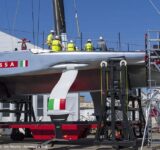
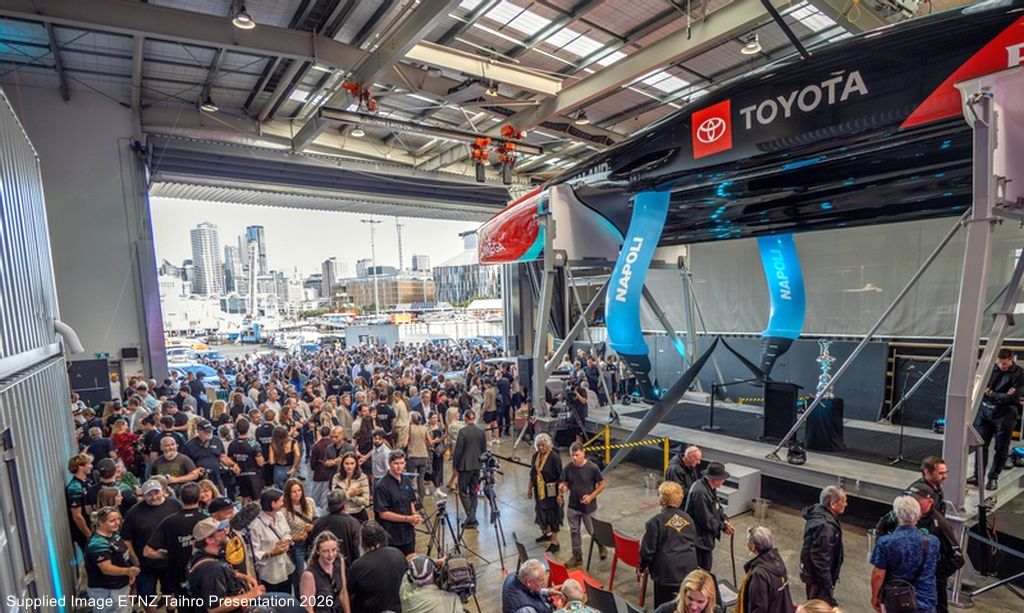
As expected, Emirates Team New Zealand are the first Louis Vuitton 38th America’s Cup team to reveal their rebuilt AC75.
Maintaining their first-mover advantage in the 38th America’s Cup, ETNZ officially revealed Taihoro ‘2.0’ their reconfigured AC75, in front of friends, families, sponsors, and long-time supporters, gathered at the Wynyard Point base in Auckland.
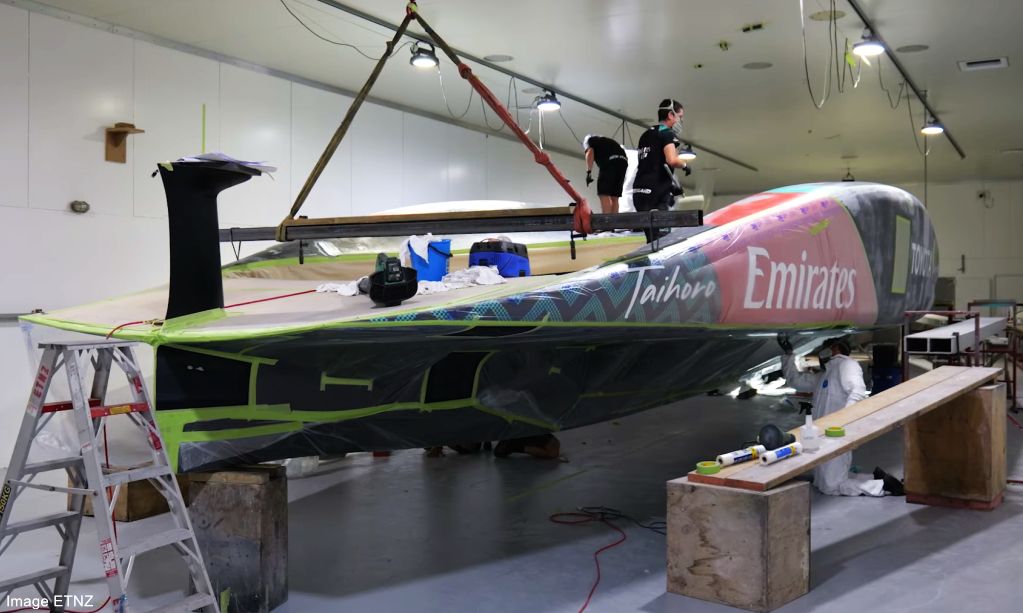
While Taihoro is the same vessel that dominated the waters of Barcelona, it has undergone a significant refit to meet the new 38th America’s Cup rules.
To remain compliant, Emirates Team New Zealand’s designers worked within razor-thin margins, limited to three specific modification categories:
- Cockpit Reconfiguration: Extensive work to transition the deck layout for the new crew requirements.
- Structural Rebuilds: The team was permitted to rebuild up to 4sqm of the hull using the same shape but different materials, allowing for localised strengthening or weight optimisation.
- Functional Rebates: Modifications were made to add rebates to maximize aerodynamic efficiency.
The reuse of the old AC75 hulls is based on the premise that; because the hulls spend so much time out of the water, there is actually not that much difference in the performance of hulls . . . a claimed 5 seconds around the racecourse across all of the boats that raced in Barcelona.
As well as the old hulls sailed in 2024 (or earlier!) teams are required to reuse a lot of legacy gear, including the spars, some sails and wingfoils.The big performance gains are expected from the foil wings and sails and the way they are controlled.
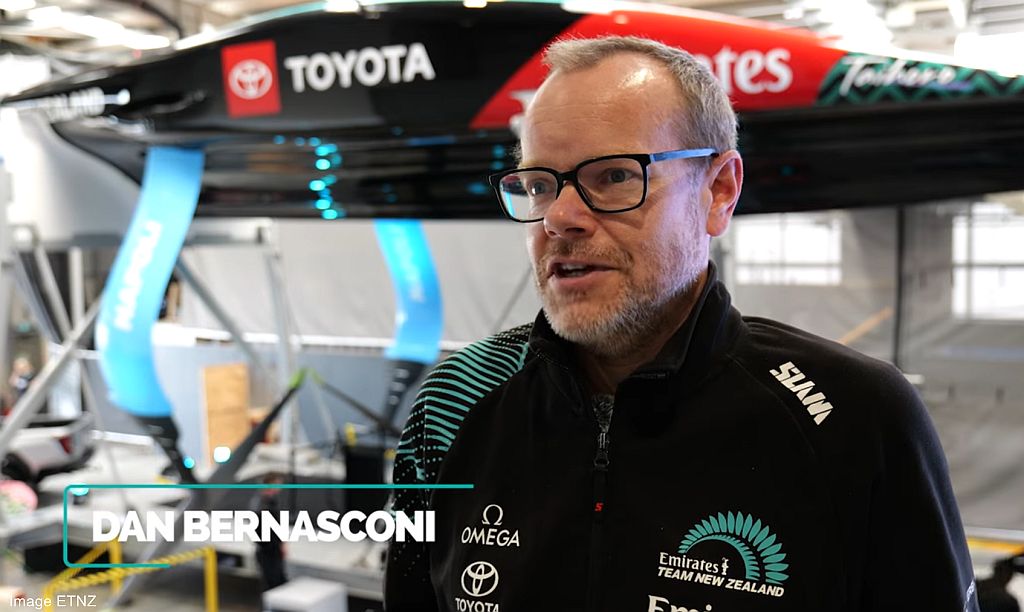
“Despite the same hulls being used again, the rules still allow for some significant technological developments and improvements in the AC75s” said Dan Bernasconi, Head of Design for Emirates Team New Zealand.
“The Class Rule and design parameters still allow for important gains and difference in performance from the foils, sails and control systems for example. As with every iteration of the same class of boat, there is no doubt the racing will be a lot closer this time around between all teams. So as always winning will be a massive challenge for the whole team.”
The presentation of the rebuilt AC75 hull did not include any roll-out or viewing of the new deck configuration, that will only be available when Taihoro is launched and the team begin to work-up the new operating systems.
The most radical visual transformation lies in the crew pod on either side of the AC75. In a fundamental shift for the class, the iconic cyclors, the leg-powered athletes who provided hydraulic pressure have been retired.
In their place sits a standardised battery system for use across all teams. This high-capacity battery is now the primary source of power for the yacht’s complex foil and sail control systems.
This technological leap has direct consequences for the crew, moving the challenge from physical exertion to digital discipline, as sailors must manage finite battery limits throughout the race.
The removal of the “engine room” has allowed for a smaller crew (five) and roles are becoming more fluid, or roles like flight control and sail trimming may be further consolidated. The change in number of sailors onboard are a hot topic of discussion with regard to how the teams will split the five roles most effectively.
A notable addition to the new layout is a dedicated guest racer pod, designed to allow a non-crew member to experience the raw G-forces of an AC75 at full flight, a feature not seen since the days of the version 5 IACC boats in 2007.
Emirates Team New Zealand will be utilising the guest racer spot throughout their sailing block in Auckland over the coming weeks.
Not wasting any time the team expect to be sailing out of Auckland Tuesday 10 March. All teams are restricted to just 45 sailing days until mid-January 2027.
The first AC38 Preliminary Regatta is scheduled in front of the Port of Cagliari, Sardinia, from 21 to 24 May 2026, a long-weekend of AC40 fleet racing. The actual 38th America’s Cup Match not until July 2027.
Other prelim events have yet to be announced by the America’s Cup Partnership (ACP) most likely delayed because until now the ACP has not had an official head.