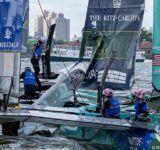
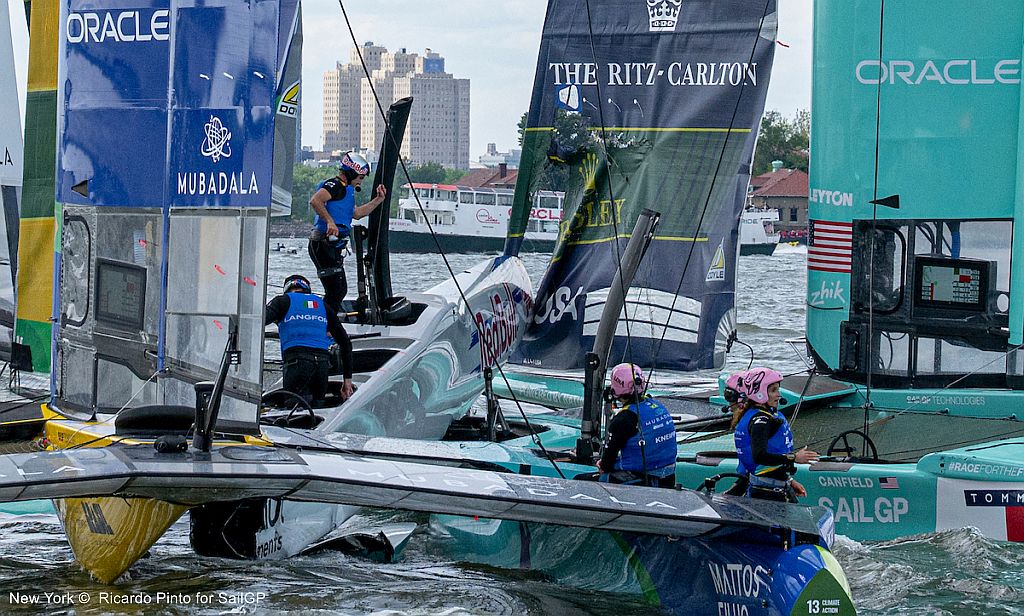
The latest three-boat collision at the Mubadala New York Sail Grand Prix left a tangle of damaged hulls, foils and structural components in its wake.
The SailGP circuit is building a reputation as the Forth Bridge of Sailing, only it’s a bit more than a continuous paint job. SailGP Technologies plant in the UK is not only producing a stream of new and replacement F50 hulls for the ever expanding number of teams. The attrition rate has also racked-up in line with the number of venues and races.
Simon Eatwell, head of engineering at SailGP Technologies, was at home watching the New York race live when the crash unfolded. “About 25 minutes later the phone rang and we were straight into response mode,” he reveals.
SailGP’s Tech Team and the teams’ shore crews burst into life to salvage the stricken F50s and start a sprint of their own – to get the cutting-edge carbon fiber machines back in action as quickly as possible.
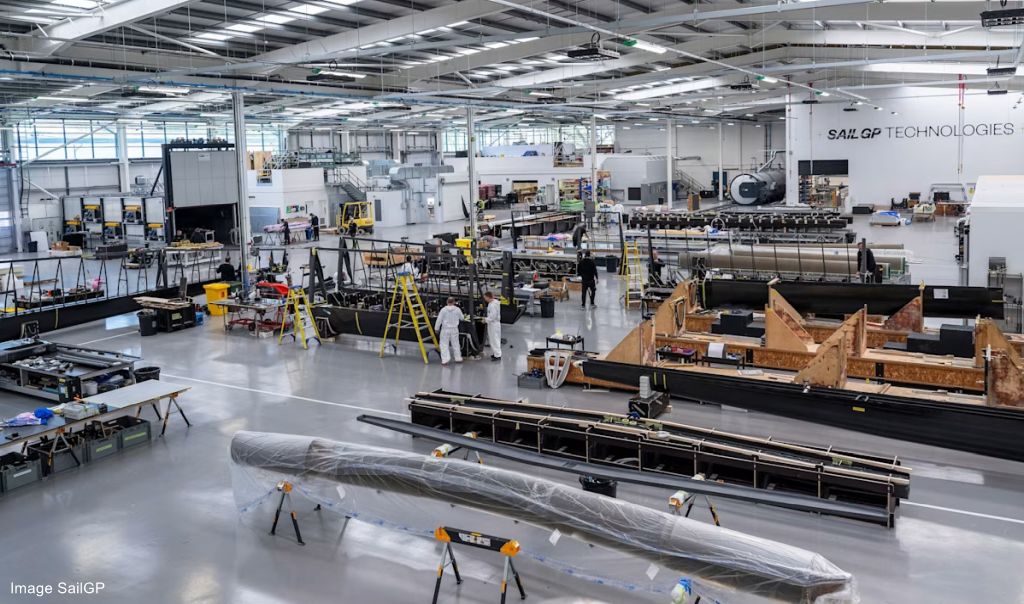
To understand what SailGP Technologies is facing, it helps to understand what an F50 actually takes to produce.
- Building an F50 requires around 57,000 man-hours
- Equivalent of roughly 40 people working full-time for nine months per boat
- In build at Southampton, three F50s, four wings and a significant volume of spare components
- While also supporting the championship from a technical operations perspective.
Joel Marginson, director of SailGP’s design and innovation center SailGP Technologies. “Right now we’re building three F50s, four wings and a significant volume of spare components, while also supporting the championship from a technical operations perspective.”
With the Canada Sail Grand Prix in Halifax less than two weeks away, the clock is ticking fast.
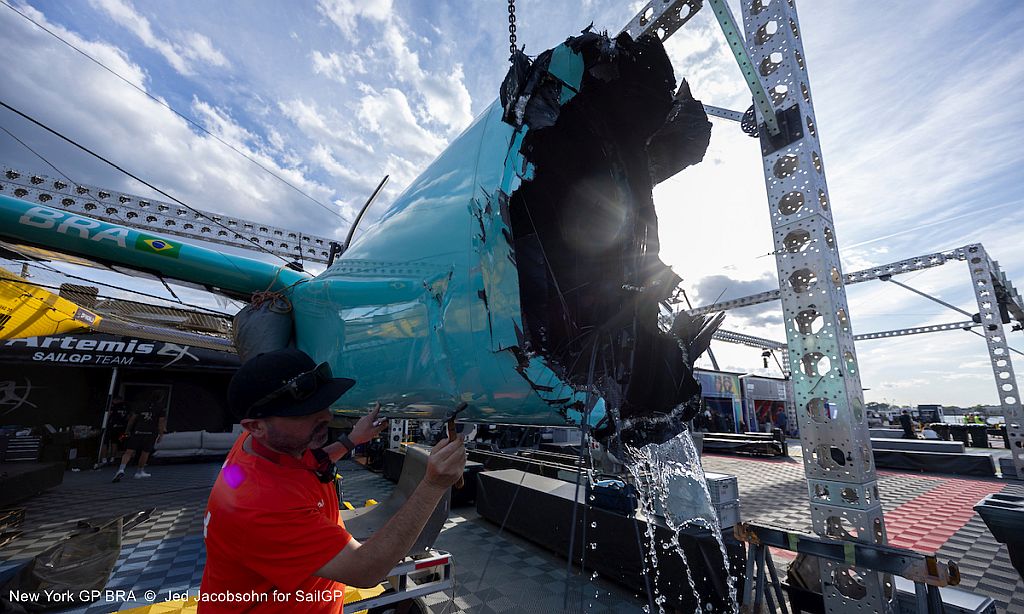
“The first stage is always the salvage operation,” Marginson explains. “Once we have the boat, we carry out an initial assessment and establish datum points and reference marks. We then gather information using NDT – non-destructive testing – and scanning technology to understand the full extent of the damage.”
That information flows instantly back to the team based at SailGP Technologies in Southampton. While one group is assessing the damage, another is already working on repair solutions. Alongside that, we’re looking at personnel, resources, logistics and timelines. There are a lot of moving parts, all happening simultaneously.
With New Zealand’s new replacement F50 complete (the result of the Auckland crash) and on its way to Canada, the SailGP Technologies team have been concentrating on the three hulls damaged in New York – The Halifax target.
For two F50s, Mubadala Brazil and the United States, Marginson is confident that despite both having extensive hull damage they will get them on the Halifax start line.
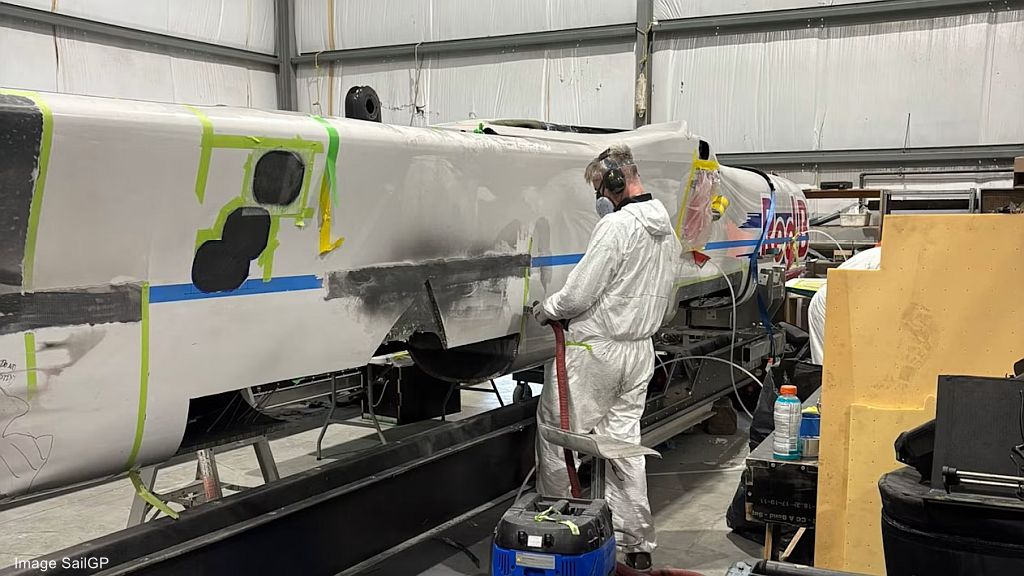
The Red Bull Italy’s repair is significantly more complex – structural issues in the wing box structure and centre case area require a substantial amount of engineering work before the team can be totally confident in the timelines.
“We’re going to give it our best shot,” Marginson says.
To give them a fighting chance a repair facility has been secured near Halifax, meaning work can continue without the delay of transporting damaged boats elsewhere. Plus parts are being expedited through production in the UK and air freighted across the Atlantic.
O’Farrell acknowledges the human cost of what lies ahead. “There will be some tough days between now and Halifax,” he says. “But if we can get 13 boats back on the start line, everyone involved should be proud of what they’ve achieved.”
The racing in Halifax begins on Saturday 20 June. The other race started the moment three boats came together on the Hudson River – and hasn’t stopped since.